
Transport type
Inoperable Vehicle Transport
Shipping for cars that won't start, built on one honest test, does it roll, brake, and steer, and one flat fee, $150 to winch it aboard.
Live carrier rates · ~30 seconds
Get your locked quote
- Route
- Vehicle
- Date & contact
Prefer a human? Call (917) 594-5566. A coordinator answers.
- +$150
- flat winch fee
- Rolls
- brakes, steers
- $649
- winch-loaded from
- 14 days
- price lock
The short answer
Inoperable vehicle transport ships cars that don't run, as long as they roll, brake, and steer, so a winch can pull them onto the trailer. Broadway loads them for a flat $150 on top of the standard rate, from $649 on a typical open lane, with $0 due until a carrier is dispatched.
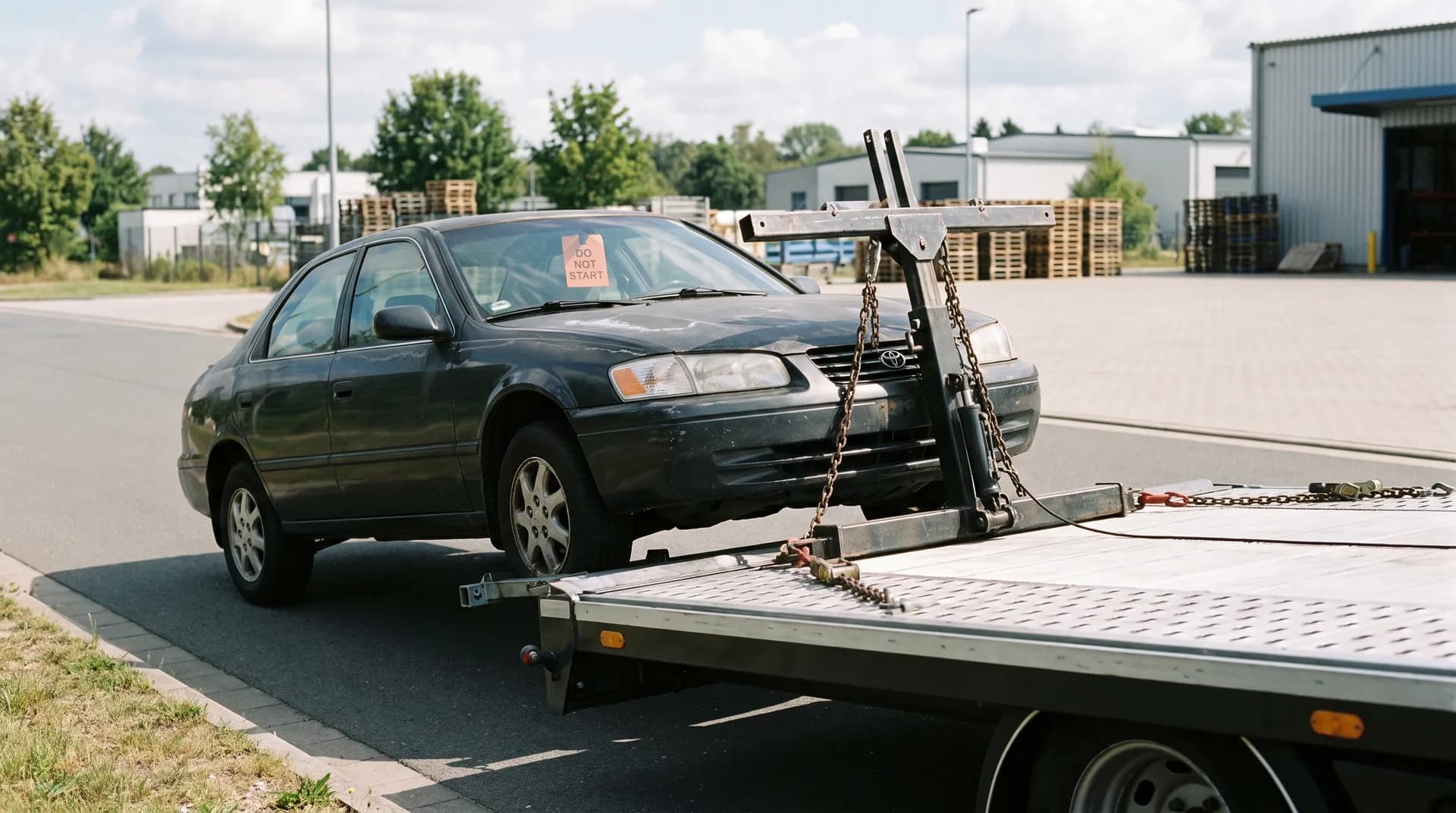
An inoperable vehicle is any car that cannot drive itself onto the trailer, whether the engine is blown, the transmission is gone, the battery is dead, or the car is a project that has not run in years. It still ships, and the method is a winch: a cable pulls the car up onto the deck while a driver guides it. For that to work, the car needs to do three things on its own, roll on its wheels, hold a brake to stop, and steer to line up straight. When it can, loading it is routine, and the only difference from a running car on your bill is a flat $150 winch fee.
The honest complication is the line between winchable and not. A car that rolls, brakes, and steers is straightforward. A car with seized wheels, no brakes at all, or a locked steering column cannot be winched safely and needs specialty equipment like a forklift or a rollback with extra gear, which costs more and runs on fewer carriers. That is a real difference, not a surcharge we spring on you, so we ask exactly what is wrong before we quote. Tell us the true condition up front and the price and the plan are right the first time, instead of a surprise on pickup day.
What it costs
What inoperable vehicle transport costs
Inoperable transport is the standard shipping rate for your lane plus one flat winch fee, as long as the car rolls, brakes, and steers. These are working figures for a winch-loaded car on a 1,000-mile open lane:
Open carrier · 1,000-mile lane · winch-loaded
Standard open runs about $750 to $1,000 for a 1,000-mile sedan, plus the flat $150 winch fee, so a winch-loaded car lands roughly $900 to $1,150, with $1,025 typical. The $649 floor is the short-lane open start plus winching, and the ceiling adds peak season and larger vehicles. It is a planning range, not a quote, and holds 14 days.
What moves the number
- Distance, longer = lower per-mile
- $0.75–1.00/mi
- Non-running, winch loaded
- +$150 flat
- Peak season (Oct–Nov, Mar–Apr)
- ±20%
- Won't roll, brake, steer
- specialty
If the car won't roll, brake, or steer, the flat $150 no longer applies. It needs specialty loading, which costs more and runs on fewer carriers, so we quote that case directly.
Your exact number takes about 30 seconds and no payment details.
See my priceLocked 14 days · $0 until dispatch
The loadable test
What does rolls, brakes, and steers actually mean?
Three plain conditions decide whether a non-running car takes the standard winch or needs specialty equipment. Rolls means the wheels turn freely and the car can be put in neutral, so the winch cable can pull it forward without dragging. Brakes means someone can stop the car on command as it comes up the ramp or deck, which keeps loading controlled and safe. Steers means the front wheels turn enough to line the car up straight, so it tracks onto the trailer instead of veering off. A car that does all three is winchable, and that is the large majority of non-running vehicles people ship.
When one of those fails, the job changes. Seized or missing wheels, no working brakes, or a locked steering column all mean a winch cannot load the car safely, so it needs a forklift, a rollback with extra rigging, or similar specialty gear. That is more expensive and available from fewer carriers, which is why the honest thing is to establish the car's real condition before quoting rather than after. We would rather ask a few blunt questions up front than send a standard winch carrier to a car it cannot load, waste everyone's day, and reprice it on the spot.
Rolls, brakes, steers
- Loading
- Winched aboard
- Fee
- +$150 flat
- Wheels
- Turn freely
- Carriers
- Standard lanes
- Cost
- Standard + $150
Missing one or more
- Loading
- Forklift or specialty
- Fee
- Quoted case by case
- Wheels
- Seized or missing
- Carriers
- Fewer available
- Cost
- Higher
The winch
How does a non-running car get onto the trailer?
A winch is a powered spool of cable mounted on the carrier, and loading a dead car with it is a slow, controlled pull rather than a drive-on. The driver hooks the cable to the car's frame or tow points, then reels it up the ramps or onto the deck while guiding the wheels and using the car's own brakes to check its speed. Because the car is not under its own power, everything happens deliberately, and a car that rolls, brakes, and steers cooperates with the process. The whole thing adds a flat $150 to the standard rate, not a percentage, so it costs the same on a cheap car as on an expensive one.
That flat fee is the honest part of inoperable shipping. Some brokers bury non-running surcharges or scale them to the vehicle, but the work of winching a car that rolls, brakes, and steers is the same regardless of the car's value, so the fee is the same. What we cannot flatten is a car that fails the test, because specialty loading is genuinely different work. For everything that passes it, the math is simple: your standard lane rate, plus $150, with door-to-door included and $0 due until a carrier is dispatched to the car. Simple is the whole idea, because a car that already will not start is enough of a headache on its own.
flat winch fee
on top of standard rate
brakes, steers
the winch-load test
due at booking
you pay after dispatch
Before you ship
What to tell us before shipping a car that won't run
The one thing that makes an inoperable booking go smoothly is an honest condition report. Confirm the basics first: does the car roll freely, can someone hold a brake to stop it, and do the front wheels steer enough to line it up? Then say exactly what is wrong, a dead battery, a blown engine, a bad transmission, no brakes, seized wheels, so we match a carrier equipped for that specific situation. And flag anything that changes access or loading, like very low clearance, a missing key, or a car parked where a winch cannot reach it. These details decide whether the flat $150 applies or the job needs specialty gear.
Broadway's job is to make sure the carrier that shows up can actually load the car. We take your condition report, assign a carrier with the right winch or specialty equipment, and send the cargo certificate before pickup. At loading, the car is winched and secured at its anchor points and photographed, then delivered and inspected the same way. Because a non-running car cannot be repositioned easily on pickup day, getting the condition right at booking is worth more here than on any other shipment. Tell us the blunt truth about the car and the plan holds. A surprise on pickup day helps no one, least of all the car sitting dead in your driveway.
- Confirm the car rolls freely, holds a brake, and steers to line up on the trailer.
- Say exactly what's wrong: dead battery, blown engine, no brakes, or seized wheels.
- Note low clearance or a missing key, which change how the car is winched.
If it won't roll, brake, or steer, tell us, and we quote specialty loading instead of the flat $150.
Is it right for you
The honest version of this decision
Book it when
- You bought a project car or non-runner and need it moved
- The engine or transmission is dead but the car still rolls
- You're relocating a car that no longer starts
- It rolls, brakes, and steers, so the flat $150 winch applies
Don't bother when
- A cheap fix would let the car drive onto the trailer itself
- The car is scrap worth less than the cost to transport it
- It can't roll, brake, or steer and specialty loading exceeds its value
- A local tow would genuinely be cheaper for a very short move
A running project worth protecting from the weather? See classic car transport.
How it runs
What an inoperable booking looks like end to end
- 01
Report the car's condition
Tell us whether it rolls, brakes, and steers, and exactly what's wrong. That decides whether the flat $150 winch applies or the car needs specialty loading, and which carrier we assign.
- 02
We match a winch carrier
We assign a carrier with the right winch or specialty equipment for your car's condition, verify the cargo policy, and send the certificate before pickup. You pay nothing until that carrier is dispatched.
- 03
Winch and secure
The driver winches the car aboard, guiding the wheels and using its brakes to control the pull, then secures it at the anchor points and photographs it. Door-to-door is included at both ends.
- 04
Inspect and deliver
Your coordinator texts status on request, and the car is winched off and inspected the same way at delivery. You check and sign the Bill of Lading at each end.
Questions
Inoperable Vehicle Transport: common questions
Still stuck? A coordinator answers the phone Mon–Sat, 9am–7pm ET.
How much does it cost to ship a non-running car?
The standard rate for your lane plus a flat $150 winch fee, so a 1,000-mile open move lands around $1,025, from $649 on shorter lanes. The fee is the same on any car that rolls, brakes, and steers. A car that fails that test needs specialty loading and is quoted separately.
What does rolls, brakes, and steers mean?
It is the test for whether a car can be winched. Rolls means the wheels turn and the car goes into neutral, brakes means someone can stop it during loading, and steers means the front wheels line it up straight. A car that does all three loads on a standard winch for the flat $150.
How is a car that doesn't run loaded onto the trailer?
By winch, a powered cable that pulls the car up the ramps or onto the deck while the driver guides the wheels and uses the brakes to control it. It is slow and deliberate rather than a drive-on. The car needs to roll, brake, and steer for the winch to load it safely.
Can you ship a car that won't roll or steer at all?
Yes, but not on a standard winch. A car with seized wheels, no brakes, or a locked steering column needs specialty equipment like a forklift or a rollback with extra rigging, which costs more and runs on fewer carriers. Tell us the exact condition and we quote that job directly rather than send the wrong truck.
Is the $150 winch fee the only extra cost?
For a car that rolls, brakes, and steers, yes, the flat $150 is the only addition to your standard lane rate. It does not scale with the car's value or the distance. The only time it changes is when the car fails the loadable test and needs specialty gear, which we quote separately and up front.
Can I ship a car with a blown engine or transmission?
Yes. A blown engine or a dead transmission does not stop a shipment, as long as the car still rolls, brakes, and steers for the winch. That covers most mechanical failures. Tell us what happened so we assign a carrier ready to winch it, and the flat $150 applies like any other non-runner.
Do I need to be there for an inoperable car pickup?
Someone 18 or older does, to sign the Bill of Lading and confirm the car's condition at each end. It can be anyone you authorize. Because a dead car cannot be moved to meet the truck, make sure it is parked where a winch can reach it, and tell us if access is tight.
Ready to ship? See your inoperable vehicles price now
- Price locked 14 days
- $0 until a carrier is assigned
- One coordinator, direct line
or call (917) 594-5566. A person answers.