
Who we serve
Classic Car Transport
Enclosed transport for collector and vintage cars, with the carrier's insurance checked against your car's agreed value before it ever leaves the garage.
Live carrier rates · ~30 seconds
Get your locked quote
- Route
- Vehicle
- Date & contact
Prefer a human? Call (917) 594-5566. A coordinator answers.
- $899
- enclosed starting
- 2–6
- cars per trailer
- +$150
- non-running winch
- 14 days
- price lock
The short answer
Classic car transport ships collector and vintage vehicles on enclosed trailers, from $899 with Broadway, secured by soft tire straps and loaded by liftgate. The carrier's coverage is checked against the car's agreed value before dispatch, and non-running classics still ship, winched aboard for a flat $150.
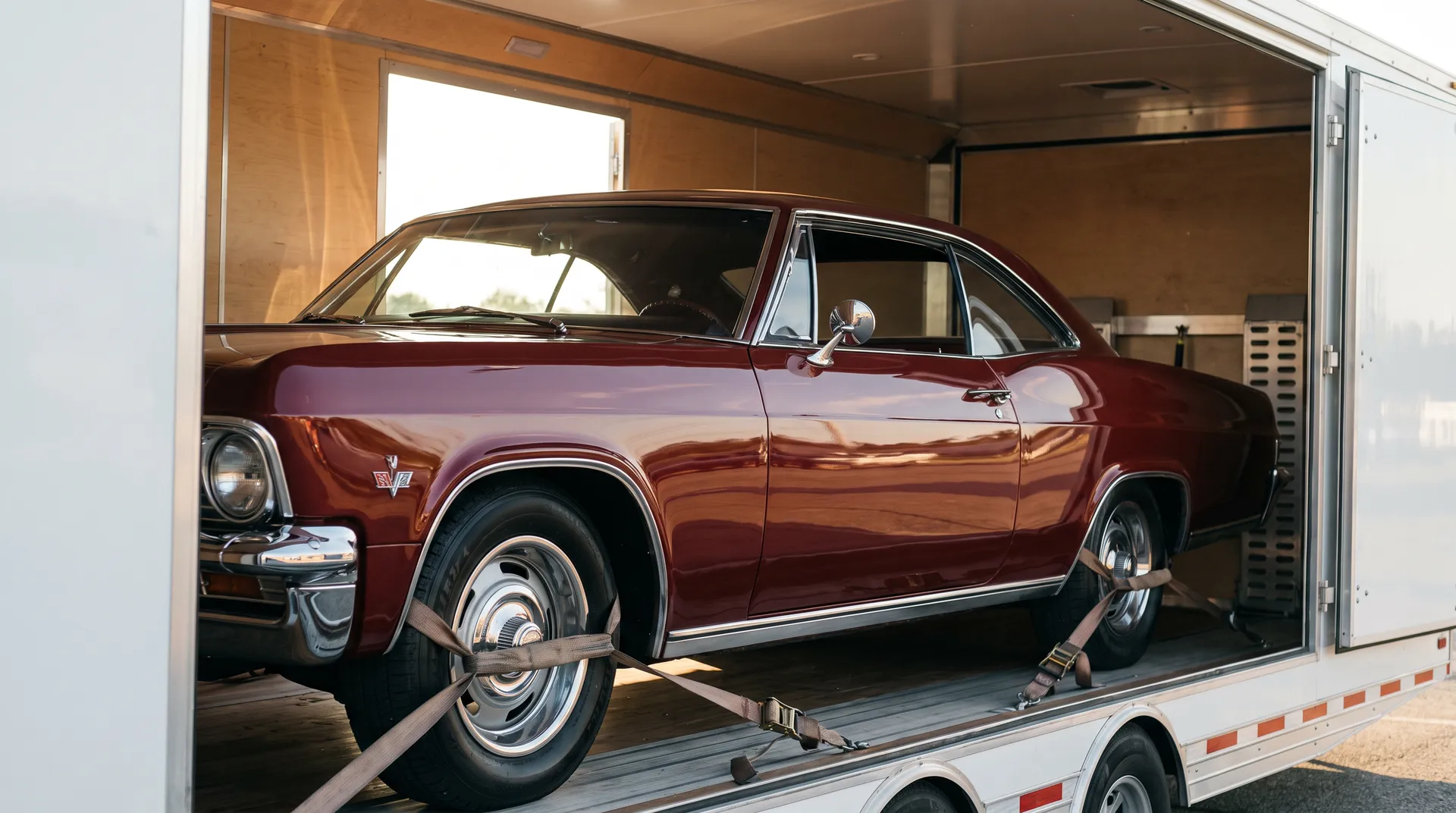
Classic car transport means your car travels inside a hard-sided enclosed trailer, out of the weather and away from road debris, secured at the tires with soft straps so nothing metal touches the paint, chrome, or suspension. Loads run 2 to 6 vehicles instead of the 9 or 10 on an open deck, and a hydraulic liftgate raises a low car level rather than dragging it up steel ramps. This is the same equipment used for exotics and show cars, because a numbers-matching original or a fresh restoration is not a car you expose to a week of highway grit. The finish is part of the value, and enclosed protects it.
The honest complication is insurance, not transport. Every carrier's cargo policy has a limit, and a policy that comfortably covers four ordinary cars can fall short of one irreplaceable one. Most brokers never show you the certificate, so nobody checks the ceiling until there is a claim. Broadway sends the cargo-insurance certificate in writing before pickup so you can compare its limit against your car's agreed or appraised value. If the numbers do not work, we re-source the load to a carrier whose policy fits. And a non-running classic still ships, as long as it rolls, brakes, and steers for the winch.
What it costs
What classic car transport costs
Classic transport is priced as enclosed shipping, which runs above open because the fleet is smaller and the trailer is sealed. These are working figures for a running classic on a 1,000-mile enclosed lane:
Hard-sided enclosed · 1,000-mile lane · running classic
Enclosed runs $1.00 to $1.50 a mile on 500 to 1,500 mile lanes, so a 1,000-mile classic lands about $1,000 to $1,500, with $1,250 typical. The $899 floor is the enclosed starting price on shorter lanes, and the ceiling adds peak season and larger or non-running cars. It is a planning range, not a quote, and your locked price holds 14 days.
What moves the number
- Distance, longer = lower per-mile
- $1.00–1.50/mi
- Peak season (Oct–Nov, Mar–Apr)
- ±20%
- Enclosed vs open, same lane
- +30–50%
- Non-running, winch loaded
- +$150 flat
Enclosed costs 30 to 50% more than open on the same lane, and the smaller enclosed fleet can take longer to assign. We quote that window honestly rather than pretend a rig is always waiting.
Your exact number takes about 30 seconds and no payment details.
See my priceLocked 14 days · $0 until dispatch
Why enclosed
Why do classic cars ship enclosed instead of open?
A classic's condition is its value, and open transport puts that condition in the weather. Over a multi-day haul an open deck collects road film, grit, and stone chips that a driver-quality car shrugs off but a show car cannot. Enclosed removes all of it: solid walls and roof, a sealed floor, soft tire straps that never touch the body or suspension, and lockable doors that keep curious hands away at truck stops. For a low classic, a hydraulic liftgate raises the car flat instead of forcing it up a ramp that a splitter or low bumper would strike. This is protection the car actually needs, not an upsell.
Open is not always wrong for an older car. A sturdy driver-quality classic making a short, dry hop, one you are not precious about, can ride open and save the enclosed premium. The line is honest and simple: if a stone chip or a week of road film would genuinely bother you, or the car is appraised well above ordinary value, enclosed is the right call. If it would not, open is money saved. We will tell you which side of that line your car sits on rather than default you to the pricier option. The car itself decides which side you are on, not our margin.
Open
- Weather & road grit
- Exposed
- Tampering at stops
- Exposed
- Low-clearance loading
- Steel ramps
- Right for a classic
- Driver-quality
- Cost vs open
- Baseline
Enclosed
- Weather & road grit
- Sealed out
- Tampering at stops
- Locked away
- Low-clearance loading
- Liftgate, level
- Right for a classic
- Show and collector
- Cost vs open
- +30–50%
Agreed value
How does insurance work for an irreplaceable car?
Cargo insurance covers the vehicle while it is in the carrier's care, but the coverage that matters for a classic is the limit, not the label. A standard cargo policy is written around ordinary cars, so it can sit well below what a restored or numbers-matching classic is actually worth. The protection you want is agreed-value or appraised-value coverage, where the figure is set in advance rather than argued after a claim. Whether that level is available depends on the specific carrier's policy, which is exactly why the certificate has to be read before the car ever loads, not filed away and hoped over.
Broadway makes that check routine. We send the assigned carrier's cargo-insurance certificate in writing before pickup, so you can compare its limit against your car's agreed or appraised value yourself. If the ceiling falls short, we re-source the load to a carrier whose policy fits, rather than move an irreplaceable car under coverage that does not cover it. Bring an appraisal or a documented agreed value to the booking, and that five-minute comparison becomes the most important thing you do before shipping, worth more than any promise printed on a website. If you do not have an appraisal yet, a recent one is worth getting before a high-value move.
insurance cert
sent before pickup
cars per load
vs 9–10 on open
non-running winch
flat, still ships
Before you ship
What to check before shipping a classic car
A little preparation protects both the car and any future claim. First, settle the number: have your agreed or appraised value in hand so you can check it against the carrier's cargo limit before the car loads. Second, build a condition record: photograph the car in detail, all panels, wheels, interior, and any existing flaws, because a classic deserves a far more thorough record than a daily driver. Third, flag the quirks: low clearance, weak brakes, a temperamental battery, a manual choke, or anything a driver needs to know to load and secure it without damage. None of this takes long, and all of it prevents the disputes that actually happen.
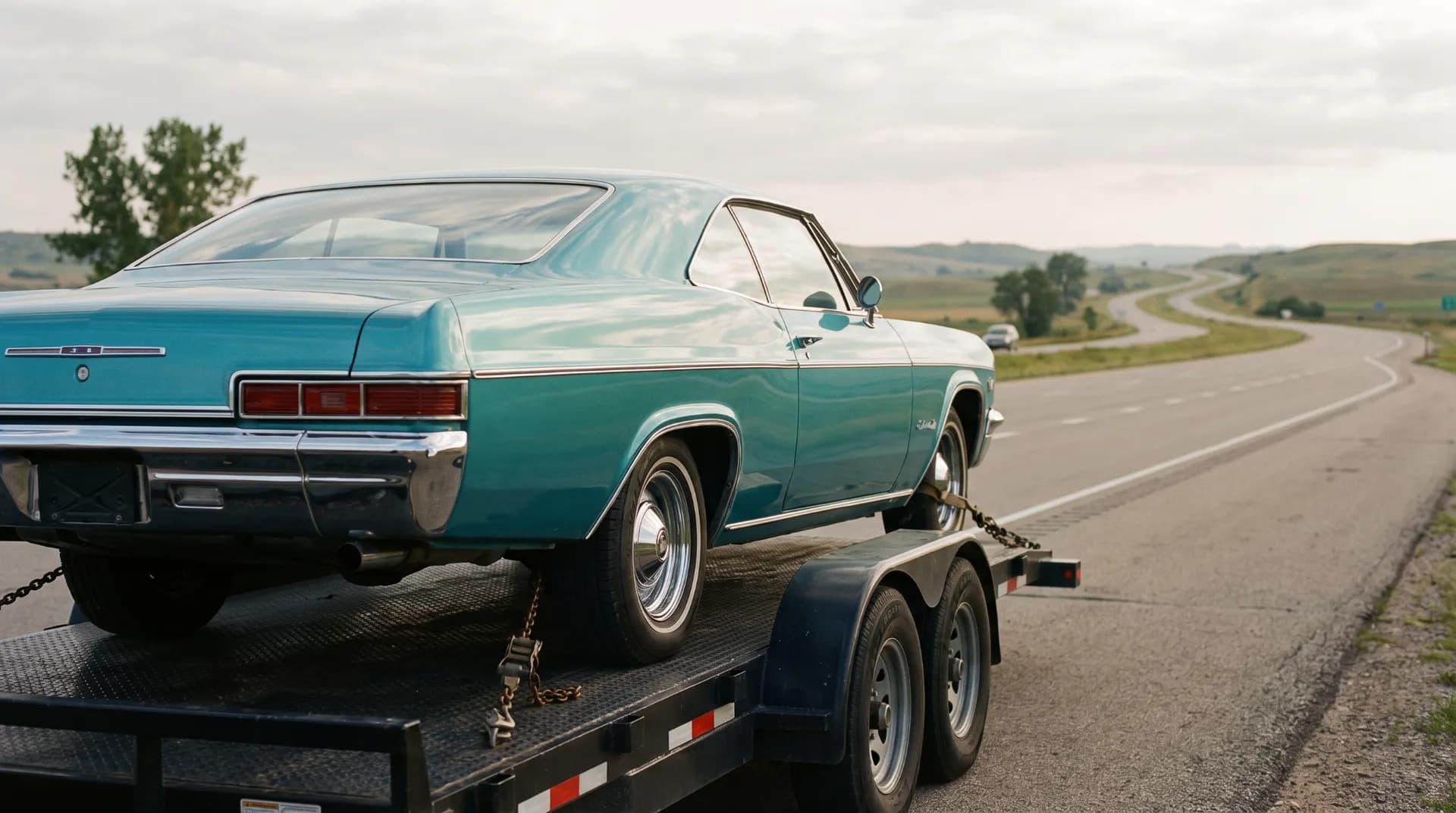
Broadway handles the rest. We match your car to an enclosed carrier suited to its clearance and value, verify and send the cargo certificate before pickup, and brief the driver on anything you have flagged. At loading, the car is secured by its tires with soft straps at marked anchor points and photographed, then delivered under cover for a full walkaround before you sign. If anything about the coverage or the equipment does not fit the car, we change the carrier, not the car. That is the whole point of shipping a classic with people who treat it as one.
- Confirm the carrier's cargo limit covers your car's agreed or appraised value.
- Photograph the car in detail at pickup; a classic deserves a thorough condition record.
- Tell us about low clearance, weak brakes, or a dead battery before pickup day.
If the cargo certificate falls short of your car's value, say so, and we re-source the carrier.
Is it right for you
The honest version of this decision
Book it when
- The car is a show, collector, or appraised vehicle
- Its finish or originality is part of what makes it valuable
- It sits too low for open ramps, or does not currently run
- You want the insurance checked against its agreed value first
Don't bother when
- It's a sturdy driver-quality classic on a short, dry route
- Open transport's savings matter more to you than sealed protection
- You'd rather drive a running classic a short distance yourself
- The car's value is not high enough to need the enclosed premium
Not a collector car but still worth six figures? See luxury car transport.
How it runs
What a classic booking looks like end to end
- 01
Tell us the car and its value
Share the make, year, clearance, whether it runs, and its agreed or appraised value. That tells us the trailer, the loading method, and the cargo limit your car needs before we match a carrier.
- 02
We match an enclosed carrier
We assign a hard-sided enclosed carrier suited to your car's clearance and value, with a liftgate if it sits low. You pay nothing until that carrier is dispatched to your vehicle.
- 03
Certificate and value checked
The carrier's cargo-insurance certificate lands in your inbox before pickup. Check its limit against your car's agreed value, and if it falls short we re-source the carrier rather than risk it.
- 04
Soft-strap load and delivery
The car is secured by its tires with soft straps, photographed at loading, and delivered under cover for a full walkaround. You inspect and sign the Bill of Lading at each end.
Questions
Classic Car Transport: common questions
Still stuck? A coordinator answers the phone Mon–Sat, 9am–7pm ET.
How much does classic car transport cost?
Classic transport ships enclosed, from $899 with Broadway, and a running classic on a 1,000-mile lane typically lands around $1,250. Enclosed runs $1.00 to $1.50 a mile on mid-distance lanes, roughly 30 to 50% above open. Your exact price locks for 14 days once quoted on your ZIP pair.
Is my classic insured for its full value?
Only up to the carrier's cargo limit, which is why we send the certificate in writing before pickup so you can check it. For a high-value car you want agreed or appraised-value coverage set in advance. If the limit falls short of your car's value, we re-source the load to a carrier whose policy fits.
Can you ship a classic car that doesn't run?
Yes, as long as it rolls, brakes, and steers so the carrier can winch it aboard, which adds a flat $150. If the car cannot roll or steer at all, it needs specialty equipment, so tell your coordinator up front and we arrange the right carrier rather than turn the car away on pickup day.
Should I ship a classic car open or enclosed?
Enclosed for anything show, collector, or freshly restored, because open transport exposes the finish to a week of weather and road grit. A sturdy driver-quality classic on a short, dry route can ride open and save the premium. If a stone chip would bother you, choose enclosed. We will tell you honestly which fits your car.
How is a low classic loaded without scraping?
By hydraulic liftgate, which raises the car flat like an elevator instead of forcing it up a ramp. Measure the lowest point at the front and tell us the number, along with any splitter or low bumper. We assign a liftgate-equipped enclosed trailer specifically, because not every enclosed rig carries one.
How do I prepare a classic car for transport?
Settle the agreed value, photograph the car in detail, and note any quirks like weak brakes, a manual choke, or a weak battery. Leave a quarter tank of fuel, disable the alarm, and secure or remove loose trim. The more the driver knows before pickup, the more carefully the car loads and rides.
How far ahead should I book classic car shipping?
About 5 to 7 days for standard timing, and 2 to 3 weeks in snowbird season, when enclosed rigs are in high demand. The enclosed fleet is smaller than the open one, so a little lead time helps us match a carrier whose trailer and insurance both fit your car rather than settle.
Ready to ship? See your classic cars price now
- Price locked 14 days
- $0 until a carrier is assigned
- One coordinator, direct line
or call (917) 594-5566. A person answers.