
Transport type
Motorcycle Shipping
Bike-specific transport with soft ties at the frame, crating where it counts, and none of the shortcuts that damage a motorcycle shipped like a car.
Live carrier rates · ~30 seconds
Get your locked quote
- Route
- Vehicle
- Date & contact
Prefer a human? Call (917) 594-5566. A coordinator answers.
- Per bike
- priced on your route
- Enclosed
- option for bikes
- Soft-tie
- at frame points
- 14 days
- price lock
The short answer
Motorcycle shipping transports your bike secured by soft straps at its frame, usually in an enclosed trailer or a purpose-built crate rather than on an open car deck. Broadway prices each move by distance and crating, with $0 due until a vetted carrier is dispatched to your bike.
Shipping a motorcycle is not shipping a small car, and treating it like one is how bikes get damaged. A motorcycle has no roof, no cage, and only two contact points with the deck, so it has to be held upright in a wheel chock and secured with soft straps at the frame or triple clamp, under even tension, never yanked down over the handlebars or seat. On the better setups the bike rides in an enclosed trailer, and for a valuable or long-distance move it can travel in a purpose-built crate that isolates it entirely. Done right, the bike never leans on its own suspension or takes strain anywhere it was not built to.
The honest part is that this is a specialist job priced differently from cars. Cost depends on distance and on whether the bike is crated or shares a trailer, and fewer carriers do bikes well than do cars, so the right match matters more than the cheapest rate. Insurance also works differently, since a bike's value and its exposure are not a car's. Broadway prices each move on its specifics rather than a generic car rate, confirms a carrier who actually ships motorcycles, and sends the cargo certificate before pickup. Tell us the bike and the route and we quote the real number, not a placeholder.
What it costs
What motorcycle shipping costs
Motorcycle pricing is set by the bike, not a standard car rate, so it is confirmed per booking rather than published as a fixed band. Bike pricing depends on distance, whether the motorcycle is crated or shares an enclosed trailer, and how many bike-capable carriers run your lane that week. What does not change: $0 due at booking, and your quote locks for 14 days once issued on your exact route.
Bikes are a smaller, more specialized market than cars, so the honest cost is a real quote on your bike and route, not a headline number we cannot stand behind.
Your exact number takes about 30 seconds and no payment details.
See my priceLocked 14 days · $0 until dispatch
How bikes are secured
How is a motorcycle secured for transport?
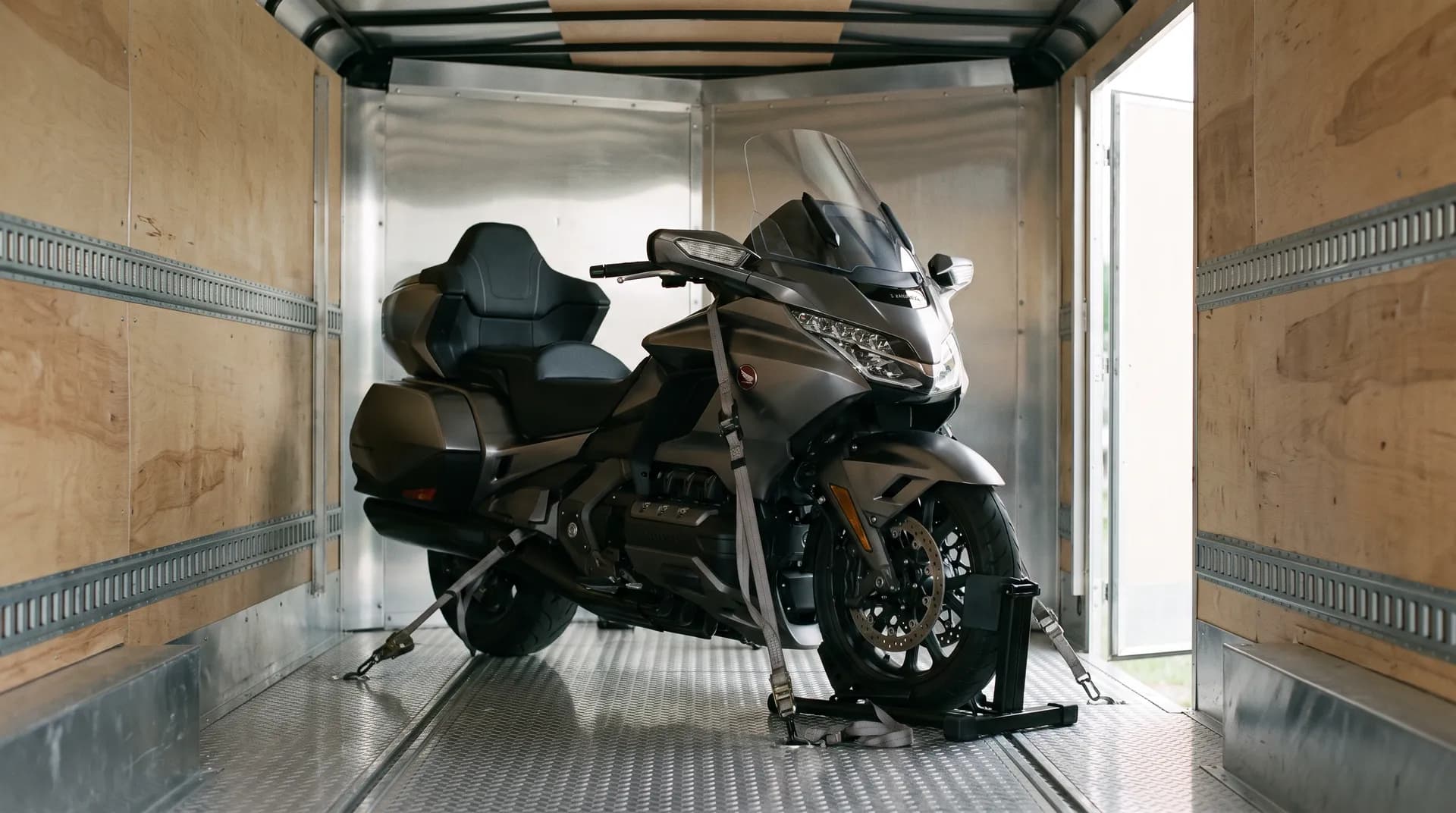
Correctly, a motorcycle is loaded into a wheel chock that holds the front wheel straight and upright, then tied down with soft straps looped around the frame or lower triple clamp, tensioned evenly from both sides so the bike sits square on its suspension. The straps never cross the handlebars, levers, mirrors, seat, or plastics, because those parts are not structural and ratcheting on them bends or snaps them. A good carrier compresses the front suspension slightly and no more, so the fork is loaded the way it is when you sit on the bike, not jammed to the stop. This is the difference between a bike that arrives as it left and one that arrives with a story.
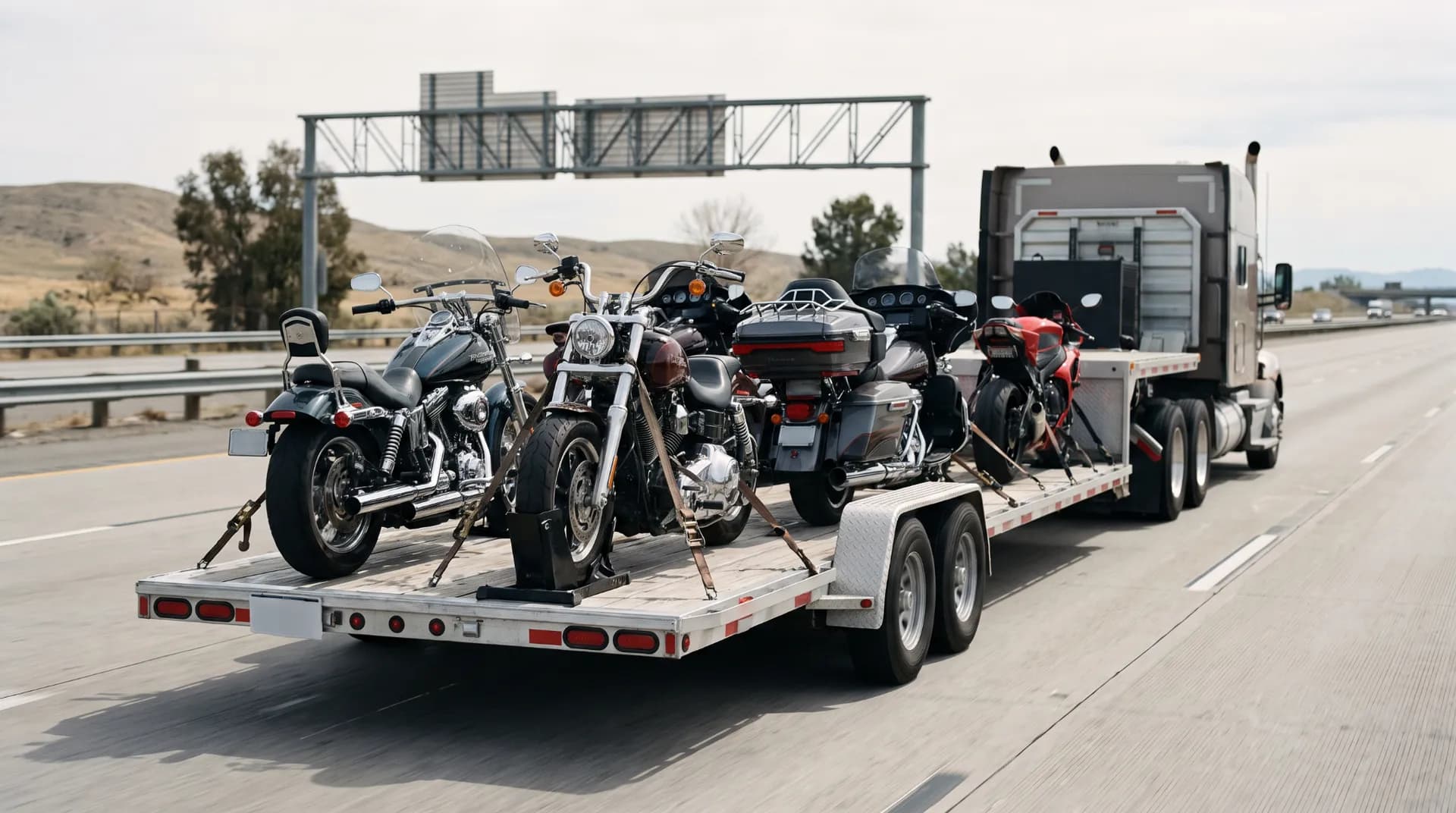
That is also why a bike does not simply ride on a spare spot of an open car deck. It needs the chock, the anchor points, and hands that have secured motorcycles before, not just cars. For a valuable, custom, or long-distance bike, an enclosed trailer keeps weather and debris off it entirely, and a purpose-built crate goes further, isolating the bike so nothing touches it in transit at all. We match the method to the bike: a rugged commuter on a short hop and a collectible on a cross-country move are not the same shipment, and we do not price or handle them as if they were.
Open shared deck
- Weather & debris
- Exposed
- Securing
- Deck straps
- Handling risk
- Higher
- Best for
- Rugged bikes, short
- Relative cost
- Lower
Enclosed or crated
- Weather & debris
- Sealed out
- Securing
- Chock and soft ties
- Handling risk
- Lower
- Best for
- Any valuable bike
- Relative cost
- Higher
Tie-down points
Why tie-down points make or break a bike shipment
Where a bike is tied down decides whether it survives the trip, so it is worth knowing before you hand over the keys. The straps belong on the frame, the lower triple clamp, or dedicated tie-down loops, places built to take load. They do not belong over the handlebars, which steer and carry brake and clutch lines, or on the seat, mirrors, or bodywork, which carry nothing and break. A bike held at the right points sits square and rides out road motion on its own suspension. A bike cranked down over the bars fights every bump and can arrive with bent controls, a tweaked fork, or worse.
The front wheel matters just as much as the straps. It should sit locked in a chock so the bike cannot fall or pivot, with the suspension compressed only slightly and tension shared evenly left to right. None of this is exotic, but all of it takes someone who ships motorcycles rather than someone fitting a bike into a car slot. When you book with Broadway, we assign a carrier equipped and experienced for bikes, and we tell you plainly whether your bike is going by chock-and-strap in an enclosed trailer or in a crate, so you know exactly how it is being held.
correct strap point
never bars, seat, or levers
chock per motorcycle
front wheel locked upright
even tension
no ratchet on soft parts
Before you ship
How to prepare a motorcycle for shipping
Prep is quick but it matters. Fold in or remove the mirrors and take off any loose luggage, hard bags, or GPS units so nothing is lost or snapped in transit. Leave the fuel low, disarm the alarm, and point out the tie-down points along with any quirk the loader should know, a temperamental kickstand, an aftermarket exhaust, a delicate fairing, or a bike that is hard to start cold. If the bike is valuable, custom, or heading a long way, ask for enclosed transport or a crate up front rather than an open shared deck, because that decision is far easier to make before pickup than to regret after.
Broadway's part is matching the bike to the right carrier and confirming the details you cannot see. We assign a carrier who ships motorcycles, not one squeezing a bike onto a car load, verify the cargo insurance and send the certificate before pickup, and brief the loader on anything you have flagged. At loading the bike goes into a chock and is secured at the frame with soft straps and photographed, then delivered and inspected the same way. If your bike needs a crate or enclosed protection to travel right, we arrange it rather than force it onto whatever deck is cheapest.
- Fold in or remove mirrors and loose luggage, and point out the frame's tie-down points.
- Leave the fuel low, disarm the alarm, and share any kickstand or starting quirks.
- For a high-value bike, ask for enclosed transport or a crate, not an open shared deck.
Tell us the make and whether it runs, so we match a carrier who ships bikes, not just cars.
Is it right for you
The honest version of this decision
Book it when
- You're moving a motorcycle any real distance, not across town
- The bike is valuable, custom, or one you care about
- You're relocating and can't or won't ride it there
- You bought a bike online and need it delivered safely
Don't bother when
- It's a short trip you would genuinely enjoy riding
- The bike is worth so little that transport approaches its value
- You have a safe truck and gear to move it yourself nearby
- You need it moved same-day on a lane with no bike carriers
Shipping a non-running or project bike? The same winch-and-secure care applies, see inoperable vehicle transport.
How it runs
What a motorcycle booking looks like end to end
- 01
Tell us the bike
Share the make, model, whether it runs, and any custom or fragile parts. That tells us whether the bike ships strapped in an enclosed trailer or in a crate, and which carrier suits it.
- 02
We match a bike carrier
We assign a carrier who actually ships motorcycles, with the chock and soft-tie setup your bike needs, and send you the cargo certificate before pickup. You pay nothing until that carrier is dispatched.
- 03
Chock and soft-tie load
The bike is loaded into a wheel chock and secured at the frame with soft straps under even tension, then photographed. Door-to-door is included, as close to your address as the truck can reach.
- 04
Inspect and deliver
Your coordinator texts status on request, and the bike is delivered and photographed the same way it loaded. You inspect it and sign the Bill of Lading at both ends.
Questions
Motorcycle Shipping: common questions
Still stuck? A coordinator answers the phone Mon–Sat, 9am–7pm ET.
How much does motorcycle shipping cost?
Bike pricing depends on distance and whether the motorcycle is crated or shares an enclosed trailer, so it is confirmed per booking rather than published as a fixed rate. You still pay $0 until a vetted carrier is dispatched, and your quote locks for 14 days. Tell us the bike and route for an exact number.
How is a motorcycle secured during transport?
In a wheel chock that holds the front wheel upright, with soft straps at the frame or lower triple clamp tensioned evenly from both sides. The straps never go over the handlebars, seat, or bodywork, because those parts break under load. The suspension is compressed only slightly, so the bike rides square on its own springs.
Should I ship my motorcycle open or enclosed?
Enclosed for any valuable, custom, or long-distance bike, because it seals out weather and road debris that an open deck cannot. A rugged bike on a short, dry route can ride open and save money. For a collector or show bike, a crate goes further still. We will tell you honestly which fits your bike.
Do you crate motorcycles?
Yes, crating is available and is the safest option for high-value, rare, or long-distance bikes. A purpose-built crate isolates the motorcycle so nothing touches it in transit, at a higher cost than a shared enclosed load. Tell your coordinator the bike and route and we will price crating against a strapped enclosed spot honestly.
Can you ship a non-running motorcycle?
Yes. A non-running bike can still be loaded and secured, though it changes how it is handled and may affect the carrier and price. Tell us it does not run when you book, along with why, so we assign a carrier equipped to load it safely rather than discover the problem on pickup day.
Is my motorcycle insured during transport?
Yes, under the carrier's cargo insurance, which we verify and send you in writing before pickup. Because a bike's value can differ sharply from a car's, check the certificate's limit against what your motorcycle is worth. If it falls short, we re-source the load to a carrier whose policy fits.
How do I prepare my motorcycle for shipping?
Fold in or remove mirrors and loose luggage, leave the fuel low, disarm the alarm, and note the tie-down points and any fragile or aftermarket parts. Share whether the bike starts easily and any kickstand or gearing quirk. The more the loader knows before pickup, the more carefully the bike is chocked, strapped, and delivered.
Ready to ship? See your motorcycle price now
- Price locked 14 days
- $0 until a carrier is assigned
- One coordinator, direct line
or call (917) 594-5566. A person answers.