
Who we serve
Dealership Auto Transport
Inventory and trade-in transport for dealers, built for volume, the release paperwork, and clean invoicing, not the one-car consumer flow.
Live carrier rates · ~30 seconds
Get your locked quote
- Route
- Vehicle
- Date & contact
Prefer a human? Call (917) 594-5566. A coordinator answers.
- $499
- per unit, from
- Volume
- fleet rates
- Invoiced
- dealer billing
- 14 days
- price lock
The short answer
Dealership auto transport moves inventory and trade-ins for dealers at volume, on open carriers from $499 per unit, with per-unit rates that fall as loads grow. Broadway handles dealer release paperwork and consolidated invoicing, verifies each carrier's insurance, and charges $0 until a carrier is dispatched.
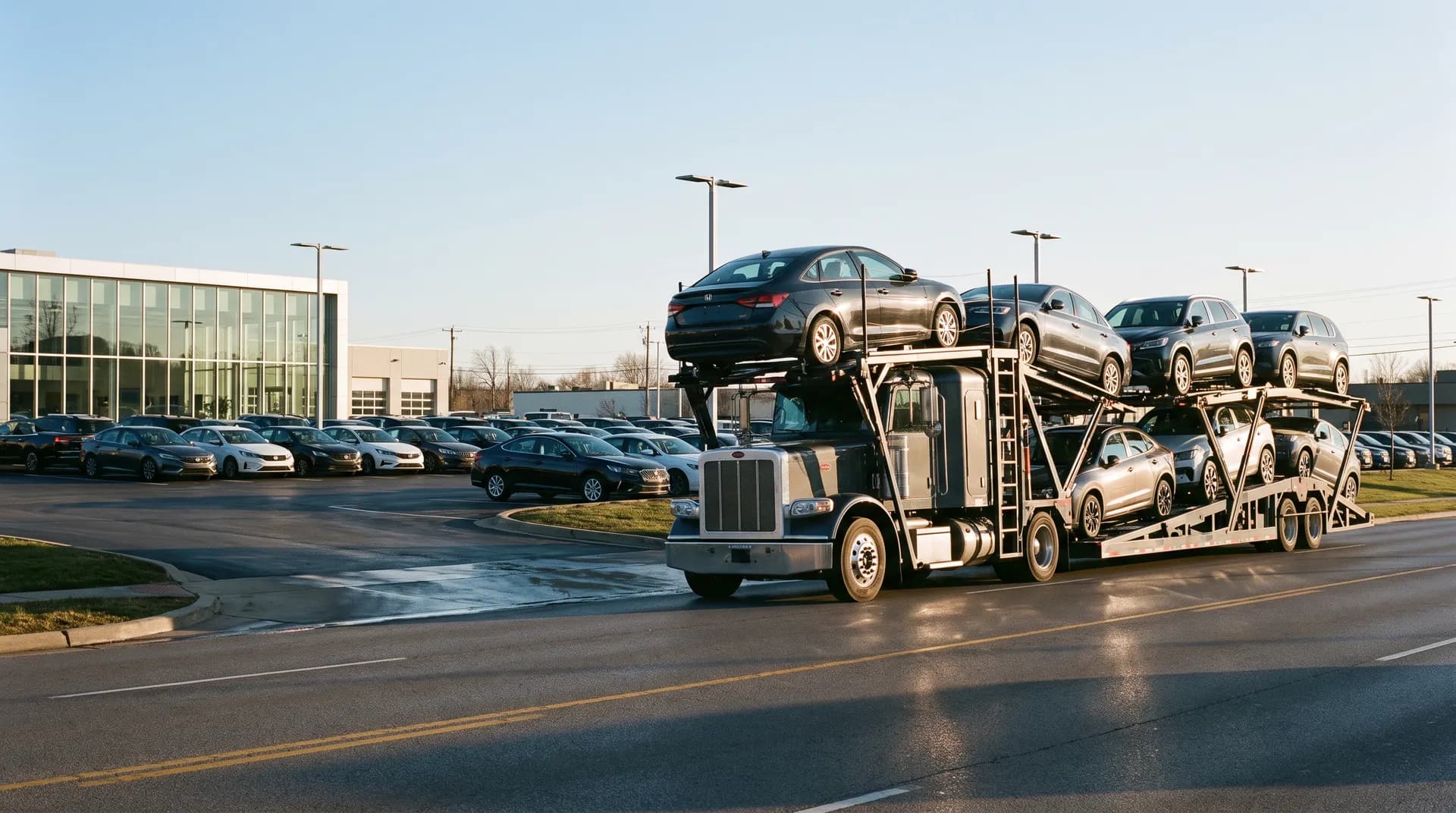
Dealership auto transport is business-to-business shipping built around how a dealership actually moves cars: inventory between lots, wins from auction back to the store, sold units out to customers, and trade-ins wherever they need to go. It runs on the same open carriers as consumer shipping, from $499 per unit, but the per-unit rate falls as volume rises, because a carrier moving several of your cars at once prices each one lower than a one-off. The point is to give a dealer one reliable transport partner for a steady flow of vehicles, rather than re-sourcing a random carrier every time a car has to move.
What makes it a different service is the paperwork and the billing, not the trucks. A dealership move needs a clear release, who at the store authorizes a unit to be picked up, and clean handling of keys and titles, since the title is not required to ship domestically but the right to release the car is. Auction pickups have their own gate and release procedures. And a dealer does not want to pay a driver per car in cash; it wants consolidated invoicing on account. Broadway is set up for all of that, so the transport fits your back office instead of fighting it.
What it costs
What dealership auto transport costs
Dealer moves ship on open rates per unit, with volume pricing that lowers the per-car cost as loads grow. These are working figures for a single running sedan on a 1,000-mile open lane, before any volume rate:
Open carrier · per unit · 1,000-mile lane
A single unit runs standard open rates, about $750 to $1,000 for a 1,000-mile sedan, with $875 typical, and multi-unit loads price lower per car. The volume discount depends on how many units and how regularly you ship, so it is confirmed on your account rather than published. It is a planning range, not a quote, held 14 days.
What moves the number
- Distance, longer = lower per-mile
- $0.75–1.00/mi
- Volume per shipment
- lower per unit
- Sedan → XL truck or SUV
- up to +40%
- Open vs enclosed, same lane
- +30–50%
Rates vary with lane, vehicle mix, and whether pickups are at your lot or an auction gate. A standing account smooths that into consistent per-unit pricing rather than a fresh negotiation on every car.
Your exact number takes about 30 seconds and no payment details.
See my priceLocked 14 days · $0 until dispatch
Volume pricing
How does dealership pricing work at volume?
The core difference from consumer shipping is that per-unit cost drops as you ship more. A carrier assigned several of your cars on one lane spreads its fixed costs across all of them, so each car prices below what a lone unit would, and a dealer with steady volume gets a better standing rate than someone shipping once. That is why the sensible setup for a store is an account rather than a string of one-off bookings: you get consistent per-unit pricing, batched scheduling, and a partner who already knows your lots, your contacts, and how you like units handled, instead of re-explaining it every time a car has to move.
An account also changes the mechanics around the price. Bookings can be batched instead of entered one car at a time, billing arrives as a consolidated invoice rather than a per-car charge, and your shipments carry account priority when capacity is tight. None of that changes the underlying open rate or the carriers, it changes the overhead of dealing with transport at all. For a dealership moving cars every week, that overhead is the real cost, and cutting it is worth as much as the per-unit saving. We will scope an account to your actual volume and lanes rather than quote a generic fleet rate.
One-off shipment
- Per-unit rate
- Standard
- Booking
- Per car
- Billing
- Per shipment
- Capacity priority
- Standard
- Best for
- A single unit
Volume account
- Per-unit rate
- Lower
- Booking
- Batched
- Billing
- Consolidated invoice
- Capacity priority
- Account priority
- Best for
- Ongoing inventory
Release paperwork
Dealer release, titles, and who signs
A dealership move hinges on a clean release, which is simply the store's authorization for a specific person to hand a specific unit to the carrier. Get that right and pickups are fast; get it vague and a driver waits at your lot or an auction gate while someone tracks down approval. The title itself is not required to ship a car domestically, which surprises people, but the right to release the vehicle is, so what matters is that whoever meets the driver is authorized to release it and has the keys. For auction wins, the auction's own gate release and buyer paperwork have to line up with the pickup, which we coordinate as part of the booking.
At each end, the Bill of Lading is the condition record, signed at pickup and delivery, and for a dealer that document is worth treating carefully: it is the proof of condition if a unit is questioned later. Broadway briefs the driver on your release process, confirms who is authorized at each location, and makes sure the keys and any needed documents are ready before the truck arrives. The goal is that a unit moves the moment the driver shows up, not after a scramble, because for a dealership a car sitting undelivered is inventory not working. Tell us how your store handles releases and we fit the pickup to it.
dealer authorizes
who can release a unit
needed to move
title not required
condition record
signed at each end
Invoicing
Billing and invoicing for dealer accounts
Dealers do not want a driver paid in cash per car, and a standing account fixes that. Set one up and shipments bill as a consolidated invoice rather than a per-car charge collected at delivery, which fits how a dealership's accounting actually runs. The specific terms, billing cycle, and any net terms are set when the account is established, since those depend on your volume and relationship, so they are agreed directly rather than posted here. What is consistent is the structure: $0 due at booking, transport billed to the account, and a single point of contact for the paperwork instead of a new transaction every time a car moves.
Making that work smoothly is mostly about clean inputs. Name the people who can authorize a release and receive units at each of your locations, so the driver always has an approved contact. Give VINs and lot or auction details with each unit, so pickups and your inventory records match and nothing is ambiguous at the gate. And let your coordinator know your recurring lanes, so scheduling and invoicing settle into a routine. Broadway sets the account up around your operation, verifies each carrier's insurance before dispatch, and keeps the billing consolidated, so transport becomes a line you manage rather than a series of fires you fight.
- Set up a dealer account for consolidated invoicing instead of per-car payment.
- Name who can authorize a release and receive units at each location.
- Give VINs and lot or auction details so pickups match your records.
Account terms and billing cycle are agreed when the account is set up, around your volume.
Is it right for you
The honest version of this decision
Book it when
- You move inventory, auction wins, or trade-ins with any regularity
- You want per-unit rates that improve with volume
- You need consolidated invoicing instead of per-car payment
- You'd rather one transport partner knew your lots and process
Don't bother when
- You have a single one-off car and no ongoing volume
- Your units only ever move within short in-house driving distance
- You already run your own reliable transport fleet
- The move is a personal vehicle rather than dealer inventory
Shipping a single personal car rather than inventory? See open auto transport.
How it runs
What a dealer booking looks like end to end
- 01
Set up the account
Tell us your lanes, typical volume, locations, and authorized contacts. We scope per-unit pricing to your operation and set the invoicing structure, so future moves are batched rather than negotiated one by one.
- 02
We assign vetted carriers
For each shipment we match insured open carriers to your lanes, verify cargo policies, and prioritize account loads when capacity is tight. You pay $0 until a carrier is dispatched to a unit.
- 03
Release and pickup
The driver picks up from your lot or the auction gate, meeting your authorized contact with the keys and release ready. Units are inspected and signed onto the Bill of Lading at pickup.
- 04
Delivery and account billing
Units are delivered and inspected at the destination, and the shipment bills to your account rather than per car. Your coordinator keeps status and paperwork in one place across all your moves.
Questions
Dealership Auto Transport: common questions
Still stuck? A coordinator answers the phone Mon–Sat, 9am–7pm ET.
How much does dealership auto transport cost?
Single units ship on standard open rates from $499, about $875 typical for a 1,000-mile sedan, and per-unit rates drop as volume rises. The volume discount depends on how many cars and how often you ship, so it is set on your account rather than published. You pay $0 until a carrier is dispatched.
Do dealers get volume pricing?
Yes. A carrier moving several of your cars at once prices each below a one-off, and a standing account with steady volume earns a better per-unit rate still. The exact figure is scoped to your lanes and volume when the account is set up, rather than a generic fleet rate posted online.
How does the dealer release work?
The release is your store's authorization for the driver to take a specific unit from a specific person. The title is not needed to ship domestically, but the right to release the car is, so your authorized contact meets the driver with the keys. For auction wins, we coordinate the gate release with the pickup.
Can you bill us on account instead of per car?
Yes. Dealer accounts bill as a consolidated invoice rather than a per-car charge collected at delivery. The billing cycle and any terms are agreed when the account is set up, since they depend on your volume. The structure stays the same: $0 at booking, transport billed to the account.
Can you pick up from auctions?
Yes. Auction pickups are a core part of dealer transport, and we coordinate the auction's gate release and buyer paperwork with the carrier so the unit moves without a wait. Give us the auction, the VIN, and the buyer details, and we line up the pickup against their release procedure.
Do you ship trade-ins and sold units to customers?
Yes, in both directions. We move trade-ins into your store, inventory between your lots, and sold units out to retail customers, all on the same account. Delivery to a retail customer works like any door-to-door shipment, with the customer or an authorized person inspecting and signing at their end.
Can you handle enclosed transport for high-line inventory?
Yes. High-line and exotic inventory can ship enclosed for the same reasons a private collector would choose it, at 30 to 50% above open. For most volume inventory, open is the sensible choice. We will mix open and enclosed across your account based on the units rather than default everything to one.
Ready to ship? See your dealerships price now
- Price locked 14 days
- $0 until a carrier is assigned
- One coordinator, direct line
or call (917) 594-5566. A person answers.