
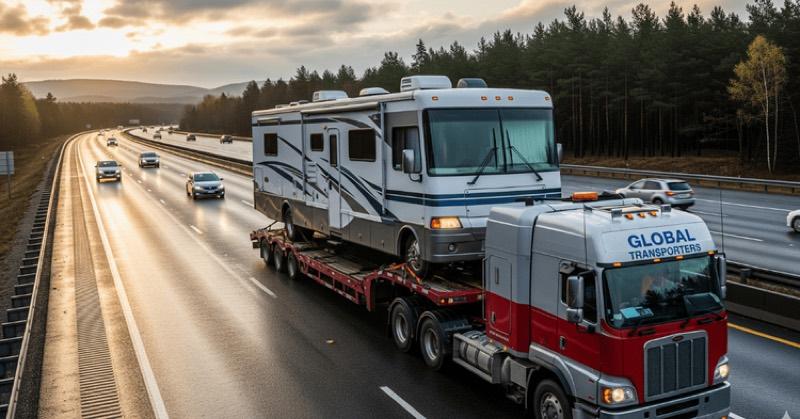
An oversized quote is only as good as the measurements under it. A truck that turns out six inches taller or a half ton heavier than the quote assumed gets repriced or turned away on pickup day, with the driver standing in your driveway. Our oversized vehicle transport page explains why size and weight cost more. This guide covers the owner's half of the job, which is taking measurements a carrier can trust.
Measure height the way a carrier will
Height decides whether your vehicle clears the upper deck of a car carrier, so it is the number that matters most. It is also the one people get wrong, usually by reading a stock figure off the manufacturer's website.
Park on level pavement with the tires at their normal pressure. Find the highest fixed point on the vehicle as it will ship. On a lifted truck that may be a roof rack, a light bar, a rooftop tent or the tip of an antenna. Lay a straight board or level across that point so it sticks out past the side, then measure from the ground up to the underside of the board. Write it down in inches.
Then take a photo of the tape against the board with the number readable. Send it with your quote request. The coordinator and the carrier then work from the same figure you measured.
If a rack, light bar or antenna is the only thing pushing the vehicle over a carrier's limit, ask whether removing it brings the truck back to standard equipment. Often it does, and that can lower the rate.
Length, width and the parts people forget
Measure length from the front-most point to the rear-most point. That includes a winch bumper, a hitch receiver or ball mount, and a rear tire carrier. A receiver-mounted bike rack or cargo tray should come off before pickup.
Width matters more on duallies and trucks with fender flares or wide wheels. Measure across the widest point of the body or tires, and measure again across the mirrors. Note whether the mirrors fold. A dually's rear axle sits wider than most pickups, and the carrier needs to know how it fits beside other vehicles on the deck.
Also list anything bolted to the bed, such as a toolbox, a cap or a flatbed conversion. Those add height, weight or both. Loose cargo in an open bed should come out entirely. A bed is open to the road, and personal items are not covered by the carrier's cargo insurance.
Know the number before you plan around it
Route-exact price in about 30 seconds. No payment details, locked 14 days.
Getting weight right
Every carrier has a legal weight ceiling for the whole load, and a heavy truck uses up allowance another vehicle would have taken. So the weight figure has to be real.
The label on the driver's door edge or door-latch post lists the GVWR, the gross vehicle weight rating. Federal rules (49 CFR 567.4) require that rating on the label, and it is the most the vehicle may weigh fully loaded. Your truck weighs less than that sitting in the driveway, and the label does not have to list curb weight at all.
For a stock vehicle, the curb weight in the owner's manual or the manufacturer's spec sheet is close enough. For a built truck with a lift, armor, a winch and bigger wheels, the honest number comes from a public truck scale. A scale ticket is the best weight evidence you can send.
When a vehicle leaves the car-carrier world
Most lifted half-tons, three-quarter-tons, duallies and full-size SUVs ship on a standard open carrier at an oversized rate. Motorhomes, large RVs, buses, box trucks and heavy equipment usually do not. They move on a specialized carrier or a flatbed, and the rules change once a load gets wide or tall enough.
The Federal Highway Administration sets the width limit for trucks on the National Network at 102 inches, and states issue special permits for loads wider than that. There is no federal height limit. Each state sets its own, and most fall between 13 feet 6 inches and 14 feet. On a trailer, the height that counts is your vehicle plus the deck it sits on, which is why a tall motorhome often rides on a low trailer like the one pictured above.
Send Broadway the real measurements for anything in this group. Your coordinator will tell you which equipment it needs and quote that directly, rather than send a car carrier that cannot legally take the load.
What it costs and what changes the price
On a typical open lane, oversized vehicles start from $1,000 with Broadway. A standard sedan on a 1,000-mile lane runs about $750 to $1,000, and a lifted truck adds up to 40% for the space and weight it takes, so it usually lands near $1,200. Peak season in October and November and again in March and April can move rates by about 20% either way. The numbers behind any quote are explained in our guide to reading a car shipping quote.
Open transport suits nearly every truck. Enclosed is available for a show build, at 30 to 50% more and with a smaller fleet to draw from. For a standard pickup within normal dimensions, open auto transport at the regular rate is the right booking.
Whatever you ship, nothing is due until a carrier is dispatched, and your quote is held for 14 days in writing.
Pickup day with a big vehicle
A full car carrier runs about 75 feet. If it cannot reach your address, the driver meets you at a nearby lot, and a large vehicle may need a wider spot than usual. Your coordinator settles the location before pickup, and the driver calls about 24 hours ahead.
At loading, the driver checks clearance and fit, secures the vehicle and photographs it. You inspect with the driver and sign the Bill of Lading. On a cross-country move, plan on 7 to 10 days coast to coast, since one driver covers about 400 to 500 miles a day.
Have your height, length, width and weight written down, then request a quote or call (917) 594-5566.