
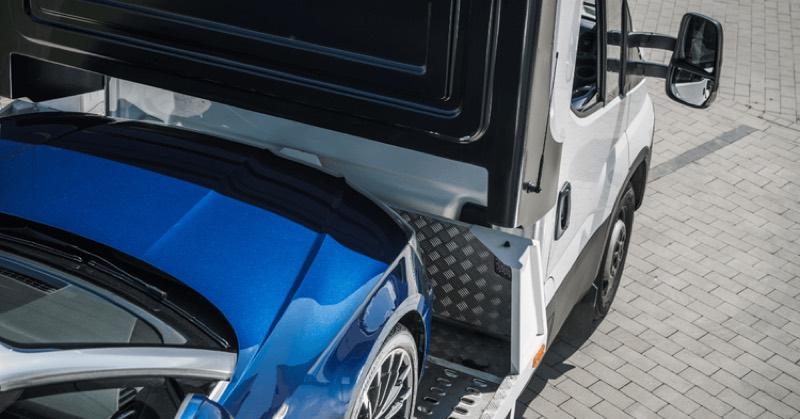
"Towing" covers three different jobs, and they don't cost or work the same. You can hire a tow truck to carry one car a short way. You can pull the car yourself behind a moving truck, a pickup, or an RV. Or you can book a spot on a car carrier that hauls your car with 8 or 9 others. Which one fits depends on three things: how far the car is going, what drives its wheels, and who is going to be behind the wheel for those miles.
The three options side by side
A tow truck
A flatbed or wheel-lift tow truck carries one car, usually the same day, and the operator does the driving. It's built for short moves: a car that died in a parking lot, a project car going across town to a shop, a purchase from a seller twenty miles away. For a trip of a few miles, a local tow is often cheaper than a carrier. Over hundreds of miles, a single-car tow gets expensive fast, because one truck and one driver are working for one car.
Towing it yourself
You rent a tow dolly or a car trailer, or you flat tow the car with all four wheels on the road behind a motorhome. You save the carrier's price and keep the car with you, with three limits:
- Drivetrain limits. A dolly lifts only the front wheels. Your owner's manual has a towing section that says whether the car can be towed with its drive wheels on the ground. Many all-wheel-drive cars and many rear-wheel-drive automatics can't, without risking the transmission. If the manual says no, a dolly is out and you need a full trailer.
- Driving with a trailer. You drive slower, stop more, and climb mountain passes with extra weight behind you. Backing up with a dolly is hard, so motel and gas-station parking takes planning.
- Your time. A 1,000-mile move is two or three long days at the wheel either way. Towing adds wear on the truck doing the pulling and fuel for the extra weight.
A car carrier
The car rides on a two-deck open carrier, or inside an enclosed trailer, and a professional driver covers about 400 to 500 miles a day. You fly or drive your other vehicle. Pickup and delivery are door to door, and when a 75-foot truck can't fit down your street, the driver meets you at a nearby lot. The carrier's cargo insurance covers the car in transit, and its condition is recorded on the Bill of Lading at both ends.
When towing wins
- The move is local, a few miles to a shop, a storage unit, or a new address in the same town.
- The car doesn't run and needs to go a short distance. A tow truck is the simplest answer.
- You're already driving a moving truck on the same route, the car is front-wheel drive, and the manual allows dolly towing.
- The car is a light runabout you plan to flat tow behind your motorhome anyway, and the manual approves it.
Know the number before you plan around it
Route-exact price in about 30 seconds. No payment details, locked 14 days.
When shipping wins
- The distance is long. Coast to coast takes 7 to 10 days on a carrier, and you aren't the one driving it.
- The car is all-wheel drive or a rear-wheel-drive automatic that the manual says can't be towed with wheels down.
- You're flying to the new place, or you have two cars and only one driver.
- The trip crosses mountains or runs in winter, and you'd rather not pull a trailer over a pass in snow.
- You want a fixed price. A Broadway quote is held 14 days in writing, and $0 is due until a carrier is dispatched.
Doing the cost math
For the carrier side, there's one number. On open auto transport, prices start at $499 on short lanes, and a running sedan on a 1,000-mile lane typically lands between $750 and $1,000. Real lanes from October 2026, for a running sedan on an open carrier: New York to Orlando about $1,150, Chicago to Phoenix about $1,060, and Dallas to Cheyenne about $830.
For the towing side, add up every line before you compare:
- Dolly or trailer rental for the days of the trip.
- The extra fuel the tow vehicle burns pulling the weight.
- Motel nights and meals for each extra day on the road.
- Days off work, if the drive takes you out of the office.
- A one-way return, if you rent the trailer at one end and drop it at the other.
On a short move the towing column usually wins. On a cross-country move, total every line before you assume the trailer is cheaper, and remember the carrier price already covers the days you would have spent driving.
The car that won't start
A dead car is the usual reason people call a tow truck, and over hundreds of miles a carrier is often the cheaper way to move it. If the car rolls, brakes, and steers, a carrier can winch it aboard. Our inoperable vehicle transport is the regular lane rate plus a flat $150 winch fee. If the wheels are seized or the steering is locked, it needs specialty loading, which costs more and runs on fewer trucks, so tell us the car's real condition before we price it.
Getting a number to compare
Price the carrier side first, since it's one figure. Enter your pickup and delivery ZIP codes on the quote page and you get a price you can hold for 14 days while you price the trailer rental. For timing on your route, see how long it takes to ship a car.