
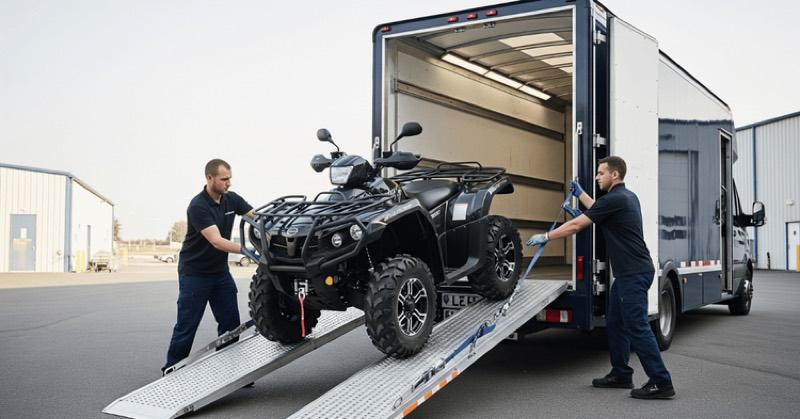
An ATV is built to be dragged through mud, so the case for shipping one in a sealed trailer is weaker than it is for a show car. A new machine, a custom wrap or a winter route across salted highways can still justify the enclosed price. This guide covers how to make that call for your quad and what to do before the truck arrives. Broadway ships ATVs and other off-road machines. Like a bike, an ATV has to be strapped at structural points instead of its plastics, which our page on motorcycle shipping explains in more detail.
Open or enclosed for your ATV
On an open carrier, the ATV rides exposed to rain, road spray and grit for the length of the trip. On a long winter route that spray carries road salt. A work quad with scuffed plastics and a few seasons on it shrugs that off, and open transport saves money.
Enclosed transport keeps the weather and road spray off entirely, and the doors stay locked at truck stops. It earns its cost in a few situations:
- The machine is new, or close to it, and you want it to arrive that way.
- It has a vinyl wrap, custom plastics, a paint job or a leather seat you paid extra for.
- The route crosses northern states in winter, when the roads are salted.
- It is a collector or vintage machine, or one you would not want sitting in the open at a truck stop.
For a car, enclosed transport generally costs 30 to 50% more than open on the same lane, and the enclosed fleet is smaller. ATVs are quoted on the machine and the route, so ask your coordinator to price both ways and compare. The enclosed car transport page explains how the trailers work, and open auto transport covers the standard option.
What to tell the coordinator
Give the make, model and year, and measure the overall width. Side-by-sides and some sport quads run wider than people expect, and the carrier needs to know how the machine sits next to other vehicles.
Say whether it starts and drives. A driver loads a running ATV under its own power, and one that will not start needs a winch and a carrier set up for it. Inoperable vehicle transport covers those moves. Mention whether the parking brake holds, since the machine has to stay put on the deck while it is strapped.
Ask a few questions back:
- Will it ride in an enclosed trailer or on an open deck, and what is the price difference on my route?
- Where will the straps attach?
- What is the carrier's cargo limit, and when will I see the insurance certificate?
Broadway sends the certificate before pickup. Under our shipping agreement, assigned carriers carry cargo insurance of $100,000 to $250,000 per load, shared by everything on the trailer. Check your own ATV policy too, since the agreement advises every shipper to review their coverage before the move.
Know the number before you plan around it
Route-exact price in about 30 seconds. No payment details, locked 14 days.
Clean it and strip it
Wash the ATV a day or two before pickup, underside included. The driver writes up the machine's condition at loading on the Bill of Lading, and a coat of dried mud hides the scratches and cracks that report is supposed to record. A clean machine also keeps dirt off whatever rides next to it.
Then strip off everything that is not part of the machine. That means cargo boxes, rack bags, gun boots, coolers, phone mounts, and any tools or ratchet straps you keep strapped to the racks. Personal items are not covered by the carrier's cargo insurance. If there is a winch, spool the cable in and stow the hook so it cannot swing. A plow blade should come off.
Leave the fuel low. Check under the machine after it sits overnight on clean ground. The shipping agreement lets a carrier refuse a vehicle that is leaking fluids or charge extra for it, so fix a leak or flag it before pickup day.
Tie-down points
ATV plastics crack under strap tension, and lights and mirrors snap. The straps belong on the frame or on the tie-down points listed in your owner's manual. Look those up before pickup and point them out to the driver. If the manual says the racks are rated as tie-down points, say so. If it does not, ask the driver to strap to the frame.
Photograph it before it loads
Take these in daylight with timestamps on, after the wash:
- All four sides and all four corners
- Each fender and body panel, with any existing cracks close up
- Racks, bumpers, the winch and any accessories left on
- The seat and the controls
- The hour meter or odometer, and the VIN
The driver photographs it at loading as well. You take the same set again at delivery.
Pickup and delivery
The driver calls about 24 hours ahead, and your coordinator texts the pickup window the day before. Door-to-door pickup is included. If a 75-foot carrier cannot reach your property, which happens on farm roads and gravel drives, the driver meets you at a nearby lot. Have the key ready, plus written steps for anything unusual, such as how to engage reverse or where a kill switch hides.
At delivery, walk the machine with your photos before you sign the Bill of Lading. Under the shipping agreement, damage that is not written on the Bill of Lading before the driver leaves is waived, and claims go to the carrier in writing within 15 days. The help center covers the rest of the delivery steps.
Nothing is due until a carrier is dispatched, and your quote is held for 14 days in writing. Price your ATV's route or call (917) 594-5566.